
by Chris Koellhoffer, IHM, April 7, 2017
Have you ever heard words coming out of your mouth, words that perhaps you’ve said multiple times, and then suddenly been caught up in a deep knowing that you’re listening to and understanding those same words in a fresh way? Almost like a first, original hearing or an experience of deep mining.
Adults often insist that they’ll never use some of the sayings their parents repeated to them as they were children growing up. Count me among those adults who are one day stunned or startled to hear themselves uttering things like, “Because I say so” or “You’ll thank me later” or some other nugget of generations past. (Here, feel free to fill in the blanks with the utterance that surprised you as it came out of your mouth in an unguarded, spontaneous moment and that echoed an earlier generation who are now appreciated as amazingly wise).
During this year’s very full Lenten schedule of retreats, days of prayer, and presentations, I was often referencing the Paschal Mystery, the suffering, dying, and rising of Jesus in history. I also spent quite a bit of time reflecting and sharing how that same Mystery of Jesus’ Passion and resurrection is happening right here, right now, in our time and place. I kept asking and inviting reflection around the question: “When, where, and in whom does Jesus continue to suffer, die, and rise in our beautiful, yet wounded world today?”
I offer profound thanks to the hundreds of people I met this Lenten season, people in Queens, Long Island, upstate New York and New York’s boroughs, New Jersey, eastern and western Pennsylvania, in cities and towns, in parishes and neighborhoods. You put flesh on the words I was saying. In your presence and your praying and your conversations, you made visible the contemporary Paschal Mystery. I listened intently as you shared your insights, as well as your hopes and your brokenness. Everywhere I went, you presented me with the reality of both crucifixion and resurrection.
Because of you, I experienced over and over an almost mystical state of being in the heart of the Holy. You made it easy to imagine how God—however we name the Divine—must be feeling as Jesus continues to journey to Calvary today, as he continues  to endure pain and anguish, oppression and exclusion in the crucified peoples of our world. Because of you, I have a palpable sense of how Jesus continues to be entombed and waiting with those who are held captive by fear, imprisoned by doubt, their dreams deferred or buried with seemingly no hope of expression or release. Because of you, I also have an overwhelming sense of how Jesus continues to rise in our world, in you who give your lives over to being agents for authentic change, who work to restore right relationship, who refuse to let sin and death have the final word, who offer yourselves as a healing presence to tend Jesus’ wounds in our fragile neighbors.
Because of you, I have already seen and walked with Jesus through Holy Week. You have lifted up for me Palm Sunday’s delight in receiving praise and affirmation; Holy Thursday’s poignant breaking of bread, tearful good-bye, letting go; Good Friday’s anguish in feeling shamed or abandoned or a failure; the anxious waiting and the hopeful wondering about what’s ahead and what’s possible on Holy Saturday; and the bursting, undaunted, irrepressible hope that is Easter Sunday.
I am so profoundly grateful for what you have revealed to me for my own life. I hold you in my heart and prayer with great care and tenderness. And I pray that we may all continue to walk with Jesus beyond this season. That we may invite the Holy to continue to act in us to bring about God’s dream for our world that continues to suffer, to die, and to rise this day and every day.
Wishing you a happy Easter and all the blessings of new life!
Takeaway
Where in your own life or in our world, do you see or experience Jesus’ suffering and dying today?
Where do you see signs of hope that point to the rising of Jesus in your family, relationships, neighborhood, country, world?
What might be needed for you to live the truth that the resurrection of Jesus has truly taken place?
To automatically receive a new blog as soon as it’s posted:
Go to the beginning of this current blog.
As you scroll down slowly, you will see a “Follow” button in the lower right hand corner.
Click on “Follow” and a form will appear for you to fill in your email address.
After you do that, you’ll receive an email asking you to verify your address.
Click on this link, and you’ll receive a confirmation that you’re now automatically subscribed.
Please note that if you’re reading the blog on your phone, you may not see the word “Follow.” Try reading it on a PC and you should have no problem subscribing.
Thanks for signing on and Following!

 forsythia bush is putting out tentative, promising buds. Indoors, my housemates—a family of African violets and English ivy–peer out at their relatives in the front yard and feel a kinship as they lean towards the light together.

 This past week of offering a guided retreat for
  work,
work, 
 Queens, one of my favorite days was Ash Wednesday. Favorite, because I always noticed something different in the faces of people coming forward to receive ashes on this day. I saw hope and desire that was transparent, direct, immediate, and insistent.
 the baggage we pack for other journeys and so we’re led to re-define what’s really necessary and important, what lives and makes a home in the heart of us.
 spiritual. How did I not realize that I had been eating a woefully unbalanced diet, heavy on cynicism and despair and light on all the things that animate and inspire?
 My Shawshank moment came at a time when hauntingly beautiful music grabbed my soul and transported me beyond the figure skating program on TV. The music invited me into an epiphany of sorts, for, like Andy Dufresne, I was also being held captive. I was imprisoned by a daily diet of news that trumpeted fear mongering and enemy-making, by feelings of helplessness, by an overwhelming sense of our collective paralysis to change direction. I needed to break out of this prison and feed myself with other sources of nourishment. I needed a change of diet. More engaged prayer. More thoughtful tending to my longing and hunger for the Holy. Upping my dose of connection to those who work for justice and embody peace. Increasing my daily intake of the arts, of music and dance and poetry and painting, food that offers a more hope-filled response to the wounds of our world.
 oice—and then I’d back away, frozen in immobility. The retreating had nothing to do with logic and everything to do with fear. The path I was already on was comfortable and familiar, but not life-giving for me, yet it was the one I knew. The possible path ahead appeared to hold the abundant life God dreams for each of us, but it was unknown. So back and forth I went. Observing this back-and-forth dance over and over, my director finally asked, “Chris, what is it that you really want?” I heard myself say, “I want an eyebrow!” I explained that I wanted to see on my director’s face some indication of the path I should embrace and choose. I wanted her eyebrow to go up or down, revealing what she thought was the better choice for me.
 discern wisely and well, gathering the best information and wisdom we can and summoning, with God’s grace, the courage we need to move into the unknown. May we listen with openness to the present moment and so cultivate a heart always ready for the crossroads ahead.
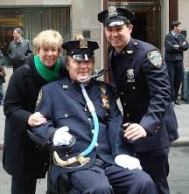 legacy of a good and holy man. I was living in New York on July 12, 1986, when Officer McDonald, a young New York City policeman, was shot three times by a teenager whom McDonald had stopped while on patrol. The shooting left the officer paralyzed from the neck down for the remaining thirty years of his life.
 Israel–areas of intense conflict and deep-seated, decades-long enmities—witnessing to the healing power of reconciliation. He chose to move forward on a spiritual journey marked by love, compassion, and forgiveness.
 considerable time to choosing the perfect name for the child of their hopes and dreams. Naming shows connection: new owners may search for just the right title as they bring an adopted pet into their home. Naming witnesses to the intimacy and closeness of relationship: we tend to name what is significant and meaningful in our lives. And naming sometimes offers us a liberation of sorts when we’re able to voice what we hold in our hearts.
 simply acknowledging the truth that God is so much bigger than we can ask or imagine and that we don’t ever want to close ourselves off from fresh revelations of the Divine. When we pay attention to the names of the Holy which most resonate with us, we can come to a revelation about who God is for us at this time in our lives: Dreamer? Lantern of Love? Mother of the Weary? One Who Weeps? The Opener or Beckoner? Sanctuary? Flute Player? Laughing One? Shelter? Friend of the Poor? Disturber? Lord of the Dance? Other? (a sampler from Fragments of Your Ancient Name)

 evening of contemplative dialogue promising a safe, sacred, non-judgmental space for people to gather following the U.S. elections. It was an experience of practicing Isaiah’s admonition to enlarge the space of our tent. In this space, we committed to make room for the other, to listen and share with openness and respect around 3 questions:

 These Advent images stand in stark contrast to what many have expressed as their feelings going into this season. In conversations, in faith sharing, in companioning people in spiritual direction, I’ve heard a litany of the same anguished life questions over and over: How can this be? What does this mean for people we love and care for, for people who feel unwanted and unheard? How are we called to be? And especially, where is God? I can resonate with all of these questions. Perhaps you can as well.
 dark prison where he’s languishing, John the Baptist asks one of the most poignant questions in all of Scripture: “Are you the One who is to come, or should we look for another?” We can imagine the fragile hope, maybe desperation, behind John’s questions. As if he were really asking, “Tell me, have I been wasting my time? My life? Am I pointing in the right direction? Give me a sign! Show me your face!”